
The Empty Cradle: Europe's Fertility Crisis

A clear and modern crisis that is overshadowed by immigration is the fertility rates crisis. This crisis is at its peak in Europe, and we can see its effects in the failure of the Social Security systems, resulting in an uncertain future for pensions.
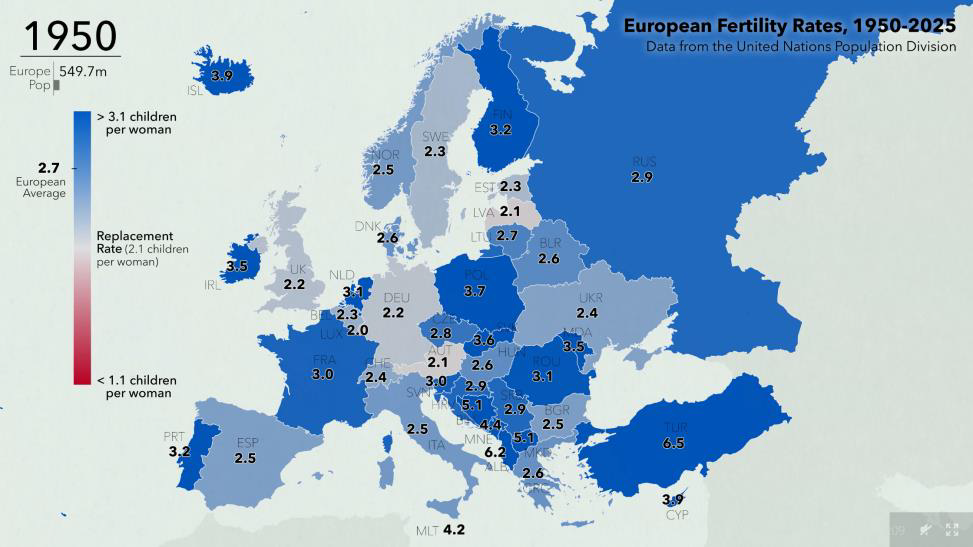
Before we try to understand its causes and effects, it is important to look at the numbers so that the discussion is grounded in evidence rather than conjecture. The first graph shows the fertility rates of the world and the continents since 1950. The following maps show Europe’s fertility rates, those in 1950 and 2025. The first one is inserted here so this article has historical conscience, because numbers without context lose most of their analytical value. Note: Fertility rates are number of children per women.


There has been a worldwide decrease in fertility rates since the fifties, after the baby boom following WWII. Europe has always had the lowest fertility rate (with one small exception in the 70s & 80s) and Africa has always had the highest and with a greater difference. Currently, while all other continents have fertility rates below the replacement level, Africa maintains a rate of more than 4 children per woman, which is more than double. The causes and effects will be discussed later. Interestingly, Africa also has the highest child mortality rate while Europe has the lowest.
Focusing on Europe, no country has its rate above the replacement rate (2.1), as the greatest is 2.1 in Monaco, which can not be seen on the map. On the contrary, Ukraine has the lowest fertility rate with a special decrease with the Russian war. This implies that in the long future, Europe’s population will diminish until extinction unless there is a shift in this trend.
The causes
How did we get to this point? What made the fertility rates lower? History has already taught us a lot about fertility rates. In the Malthusian Epoch, from the beginning of mankind until the Industrial Revolution, when there was a surplus of goods, the fertility rates grew until the goods per capita went back to the standard, when the fertility rates decreased again. When the Industrial Revolution came, everything changed. Population grew with the surplus of goods but then it stopped to grow as much as parents were investing in the literacy of their children, as with the technological progress more jobs, and better paid, required more education. Parents preferred less children more educated than more children less educated, the famous quantity-quality trade-off is an old known.
Moreover, the increase in life expectancy increased the marginal surplus for more extensive education. Furthermore, women’s increased participation in the labour market to sustain the family, as children did not work anymore, which meant the opportunity cost of having one more child increased. There are clear strong negative correlations between fertility rates and women’s and men’s education, the gender’s pay gap and child mortality rates. So, there is a strong correlation between economically developed societies and lower fertility rates. This is consistent with Africa having the greatest fertility rates by far. The fertility rates have been lowering and will for now maintain this trend.
These are not the only changes in culture that led to the diminishing desire for children. Firstly, the secularization of the countries has made children less desirable, and sex is mainly seen as a simply pleasurable activity with no intrinsic reproductive meaning. Furthermore, the divorce rates are high, and the marriage rates have never been lower. Finally, people also prefer luxurious lives instead of having more children.
We have now understood why people want fewer children, but people still have sex, so how are children not being born? There are two and only methods broadly known: one which terminates the pregnancy, and other which prevents pregnancies. Firstly, in 1950 only Sweden and the USSR permitted abortions. Throughout the 20th and 21st centuries almost every European country has legalized abortion. Only five countries have not yet legalized, including Monaco. Nowadays, 29% of pregnancies end with an abortion, this means 73 million babies killed per year, 200 000 per day, and 2 babies per second. This factor has been very impactful to keep the fertility rates low, as we can see from the decree 770 in Romania, which prohibited abortions and made the fertility rate double. The fertility rate would diminish gradually with the increase of illegal abortions.
In parallel, there has been an increase in distribution of contraceptive methods, such as pills and condoms, many times distributed by public entities to prevent the spread of STDs and other reasons. This has been accounted as the greatest impactor to reduce the fertility rates.
This culture, fruit of the capitalist regime, which does not value life itself as much, has an intrinsic ignoble moral. However, it seems rational according to the effects in the matters of sustainability, as if the fertility rates don’t lower, the resources will be scarce, but I have never supported the Stuart Mill’s moral theory.
The effects
The effects that can be predicted are numerous, impacting several industries and fields. I’ll focus on mentioning those which seem more important and interesting.
Firstly, there will be a growth of migrations and a new world order. As the European populations die out, especially African, but also Asian migrants, will replace them. These populations will grow and become more powerful. The European cultural integration, unfortunately, is not as efficient as the one of its ancestor, Rome.
Secondly, Social Security systems will become increasingly unsustainable as the active population becomes proportionally smaller over time. The only factor that can sustain it is migration. So in order to control or close the borders, Europeans have two possible choices, have lots of babies or end/reform deeply social security. This is why European politicians don’t close the borders, as the social security system reform will be extremely difficult and costly in popularity, and in democracies the people’s support is crucial. Furthermore, the life expectancy has increased which also worsens the situation, as retirements are longer. One policy to fight this, which would be rather interesting, would be to peg the retirement age to life expectancy. But, once again, it wouldn’t be a very popular policy.
Thirdly, the other new world order, AI. The automation of many processes brought diminishing needs of human labour. Therefore, these decrease in fertility rates will
decrease the once probable future growth in unemployment rate. (Even though AI also brings new jobs.)
Fourthly, the recent phenomenon of overpopulation will be mitigated in parallel with the scarcity of resources. Linking with migration, if Europeans don’t reproduce as much for sustainability, the debate that arises is if some African and Asian countries can reproduce irresponsibly and overpopulate the earth. Furthermore, they might bring the culture that made them migrate to European countries.
Fifthly, interestingly, we might predict that real estate might be close to its peak which would be a relief for the European governments trying to solve the housing crisis. While the population decreases so does the demand for housing, but the growing desire for luxury might keep the market at similar levels.
Sixthly, the potential GDP will diminish as less people produce, and in the long run the actual GDP will also diminish. However, GDP per capita, will most likely increase in parallel with technological progress and population reduction.
Seventhly, there will be a likely growth of Christianity, Catholicism and conservatism, as these families usually have more children, following the command of God in Genesis 1:28 “be fruitful and multiply” and of the popes such as St. John Paul II. The growth will be subject to a degree of unpredictability, while looking at the fertility rates, as many factors affect religiosity such as persecution, and new discoveries. It can be argued that some Christian children lose the faith. However, that’s not the case for the majority, and those who remain faithful will then most likely have more children.
Possible Policies
Many policies can and have been implemented to affect the fertility rates of the population. The first measure is tax incentives such as IRS deductions per child. The second measure is to ban abortion and/or contraceptives (Roe v Wade & Decree 770). A lighter version of this measure is to simply not support and not use public funding on abortions and contraceptives. However, this measure could increase inequalities as the poorer families won’t be able to have abortions, so the ban would be better. The third policy can be cultural incentives and other types of benefits. Exempli gratia, the endorsement of the prime minister to have children, discounts to big families, etc… The fourth and rarer is to limit the quantity of kids per family, which has been used in China for example (One child policy) to fight overpopulation.
Many years from now, the population, if this trend continues, will become dangerously small. To ensure the subsistence of the human race, policies to incentivize reproduction will be made, but it might be too late for some reasons such as biological infertility, which has grown over time, and the Low Fertility Trap. The Low Fertility Trap states that below a rate of 1.5 it’s very difficult to revert to previous higher levels as we get stuck on a vicious cycle: low fertility rates – less active population – economic stagnation – less trust to have children.
It seems to me that we need to increase European’s fertility rates as otherwise there will be a population substitution from migrants and a loss of our great culture. Moreover,
the Social Security systems need urgently a reform. The fertility increase doesn’t have to be great as life expectancy has also grown. Furthermore, the fertility rates are well below sustainable rates, which sooner or later must be increased.
Sources:
The Journey of Humanity, Oded Galor


Comentários