
Democracy on Paper, Cartels in Power: The Political Economy of Narcotics in Latin America
- Matilde Alves
- 31 de mar.
- 3 min de leitura
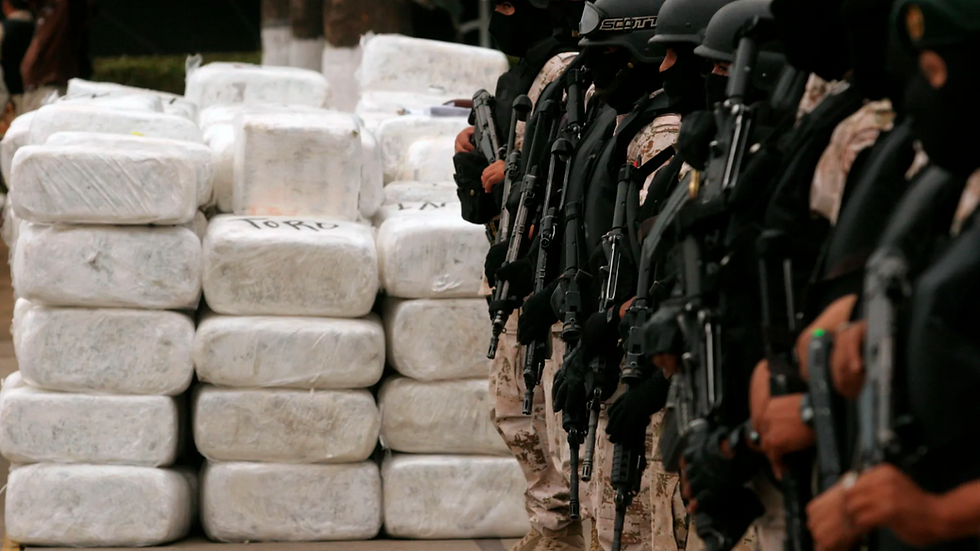
The narcotics economy in Latin America is viewed as a security concern as well as a political-economic system that transforms illicit wealth into political power and affects macroeconomic balances. The cartels are not seeking political power in Latin America as part of an ideological agenda but rather motivated by economic gains. To attain this, they infiltrate the political system by financing political campaigns, bribing law enforcement officers and prosecutors, and paying local governments to provide parallel public services in areas where the state fails to provide them. As such, democracy becomes procedural with elections characterized by low political competition, local governments dominated by entrenched political blocs, and citizens dissatisfied with the state’s capacity to protect their rights.
Mexico is one of the countries in Latin America where democracy is more formal than substantive. It has faced many violent attacks on candidates and their teams in the run-up to the elections. In the run-up to the 2024 elections, reports indicate that there have been 231 deaths, including 34 candidates. This situation dissuades political participation and favors groups willing to make concessions to the cartels. Local governments dominated by the cartels provide deficient public services and implement policies that favor illicit profits. The removal of key political actors does not affect the cartels’ operations, as was seen in the coordinated attacks following the death of Nemesio ‘El Mencho’ in last February, which resulted in the deaths of many individuals and involved roadblocks and arson attacks in various states.
The cases of Mexico and Colombia represent different facets of the role of illicit networks in undermining formal political and economic structures. Mexico represents the issue of political capture of formal structures, while Colombia represents the issue of reorganizing rural economies. The ongoing nexus of insurgency and narcotics production has now become a reality where criminal groups and networks involved in narcotics trafficking dominate rural space, land markets, and value chains. New assessments indicate that approximately 253,000 hectares of land in Colombia were used for coca cultivation in 2023, with a potential for producing 2,664 metric tons of cocaine, thus providing additional resources for armed groups and informal political networks.
The crisis caused by these illicit transnational networks, however, is not contained within the borders of these producer countries. The United States, for example, is experiencing an overdose crisis, with 105,000 deaths in 2023, of which 69% are attributed to synthetic opioids such as illicit fentanyl. This demonstrates the transnational effects of these networks, which are associated with Mexico. Whereas tracing back chemicals and seizures reveals that an estimated 84-90% of US imports of powder cocaine, is associated with Colombian production. This demonstrates how demand and profits in these distant countries are financing rents that are used for violence, corruption, and institutional capture in these countries in Latin America.
To address this crisis, it is necessary to implement various levels of intervention. In the short term, it is necessary for countries to protect democratic competition by strengthening security for candidates, improving electoral logistics, and strengthening investigative capabilities. In the medium term, it is necessary for countries to reform their police forces, judicial systems, anti-money laundering regulations, and campaign finance rules. In the long term, governments should also invest more in rural development, education, and access to markets to give these vulnerable groups legitimate alternatives to crime.
However, this is not enough. Demand reduction strategies must also be implemented in the United States, given that the strength of cartels lies in their ability to generate profits from these markets. This includes not only investing more in demand reduction strategies, treatment, and public health programs, but also investing more in drug interdiction. If the United States were to increase its ability to detect drug trade movements, especially across land, sea, and chemical precursor imports instead of immigration, it could potentially reduce the profits of these cartels.
The key challenge is how to reduce the profits that fuel cartel power while at the same time making it significantly harder for criminal organizations to capture and suborn state institutions. Without this twin imperative, democracy in Latin America risks being largely formal, with power increasingly exercised outside the law rather than through it.


Comentários