
Argentinian Inflation Battle: Austerity and its Burden
- Lorenzo Milana
- 28 de jun. de 2024
- 3 min de leitura
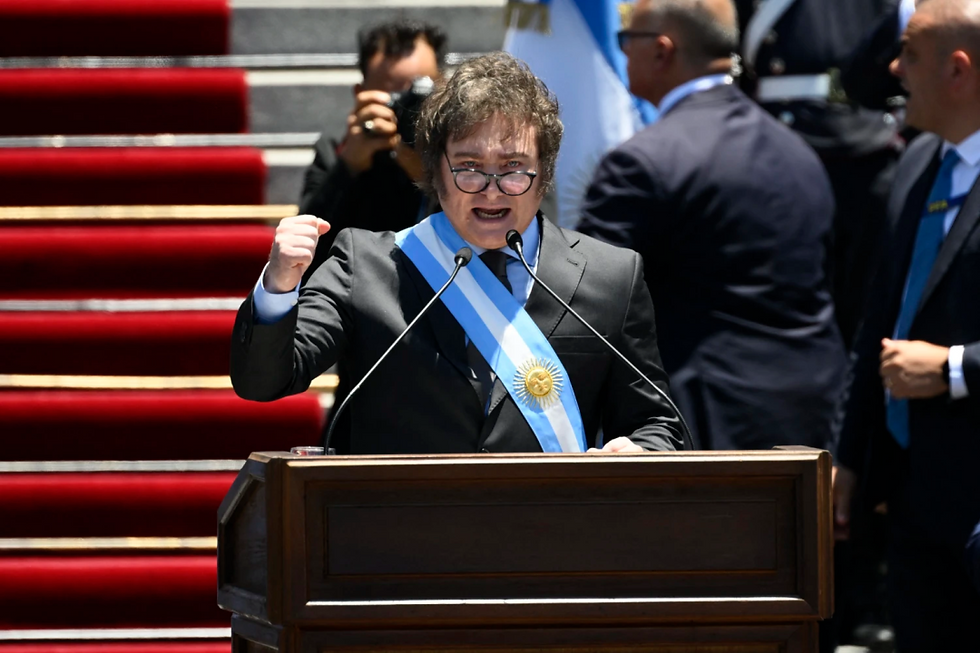
Last November, the Argentinian people casted their voices to initiate a long-awaited spark of change. The establishment embodied by the Peronist ruling, claiming their name after populist past president Juan Domingo Peron, this time had to come to terms with an indisputable truth: Argentinians were fed up.
Decades of elephantine government budgetary issues and galloping inflation had eroded the political support for traditional political figures setting the ground for Javier Milei, the unorthodox candidate from the right-wing coalition, La Libertad Avanza.
As unexpectedly as he arrived, Milei took over the country's reins and immediately sought to instill in the parched Argentinian economy the seeds of his righLast November, the Argentinian people casted their voices to initiate a long-awaited spark of change. The establishment embodied by the Peronist ruling, claiming their name after populist past president Juan Domingo Peron, this time had to come to terms with an indisputable truth: Argentinians were fed up.
Decades of elephantine government budgetary issues and galloping inflation had eroded the political support for traditional political figures setting the ground for Javier Milei, the unorthodox candidate from the right-wing coalition, La Libertad Avanza.
As unexpectedly as he arrived, Milei took over the country's reins and immediately sought to instill in the parched Argentinian economy the seeds of his right-libertarian thought. His prescribed medicine for the country dictates the confinement of the Government’s role to leave the market functioning unbothered. On the other hand, the titanic challenge posed by historical trends in inflation is countered by relentless austerity. All these changes are intendedt-libertarian thought. His prescribed medicine for the country dictates the confinement of the Government’s role to leave the market functioning unbothered. On the other hand, the titanic challenge posed by historical trends in inflation is countered by relentless austerity. All these changes are intended to be as drastic as possible to increase credibly the possibility of exiting the lingering state of crisis, enshrouding the Argentinian economy.
With over 40% of the population in poverty and an inflation rate peaking around 150%, the chronic conditions looming over the country are far from easy to convert. Since his vestment as President of Argentina, the market has embraced favorably Milei’s prescription, while the costs are left to scar the defenseless sections of the population.
By removing heavy subsidies, decreasing the size of the government and devaluating the peso, Argentina recently registered its first quarter of fiscal surplus since 2008. After the initial devaluation, the currency appears to be stabilizing with the black market exchange rate. Nonetheless, the reduction in spending power is slashing demand and pushing supply to adjust abruptly. The adjustment phase will still need to recover the now-sacrificed internal consumption over time, for it to be finally experienced by the population. But it might be too late to recover the prevalent political sentiment of the public opinion.
Although in strictly economic terms, the macroeconomic trends appear to scratch the cemented immobility of Argentina, political considerations indeed cannot fail to be included. On the one hand fiercely enforcing austerity measures, even if needed, always requires at least recognizing that what is deemed as textbook-achievable in reality must, more often than not, come to compromise with its politically feasible counterpart. The severe recession prospected might easily divert the electoral wind currently blowing in Milei’s sails. People are bearing the consequence of this harsh disruption while only witnessing from a distance the flaunted economic achievements. With time, they may retrieve their support for the current majority. If this verifies, future necessary adjustments may be hindered and quelling the burgeoning discontent may not be straightforward.
Dampening economic policies is not always feasible, but deliberately averting even attempts to do it, may bear longer consequences than expected. Trade-offs in the speed of adjustment are always present; in this case, the resilience of the population is entrenched in the degree of frustration released by the Peronist governments. However, in a war of attrition between austerity and its cumbersome consequences on the citizens, many may indulge in appraising Milei as the Savior of the country, falling into the trap of short-sighting the real sacrifice endured by the Argentinians in their daily lives. Failing to ingrain this suffering in the external perception of the current macroeconomic turnaround is a disservice to the complexity of real economic issues; something that informed citizens should not tolerate.



Comentários